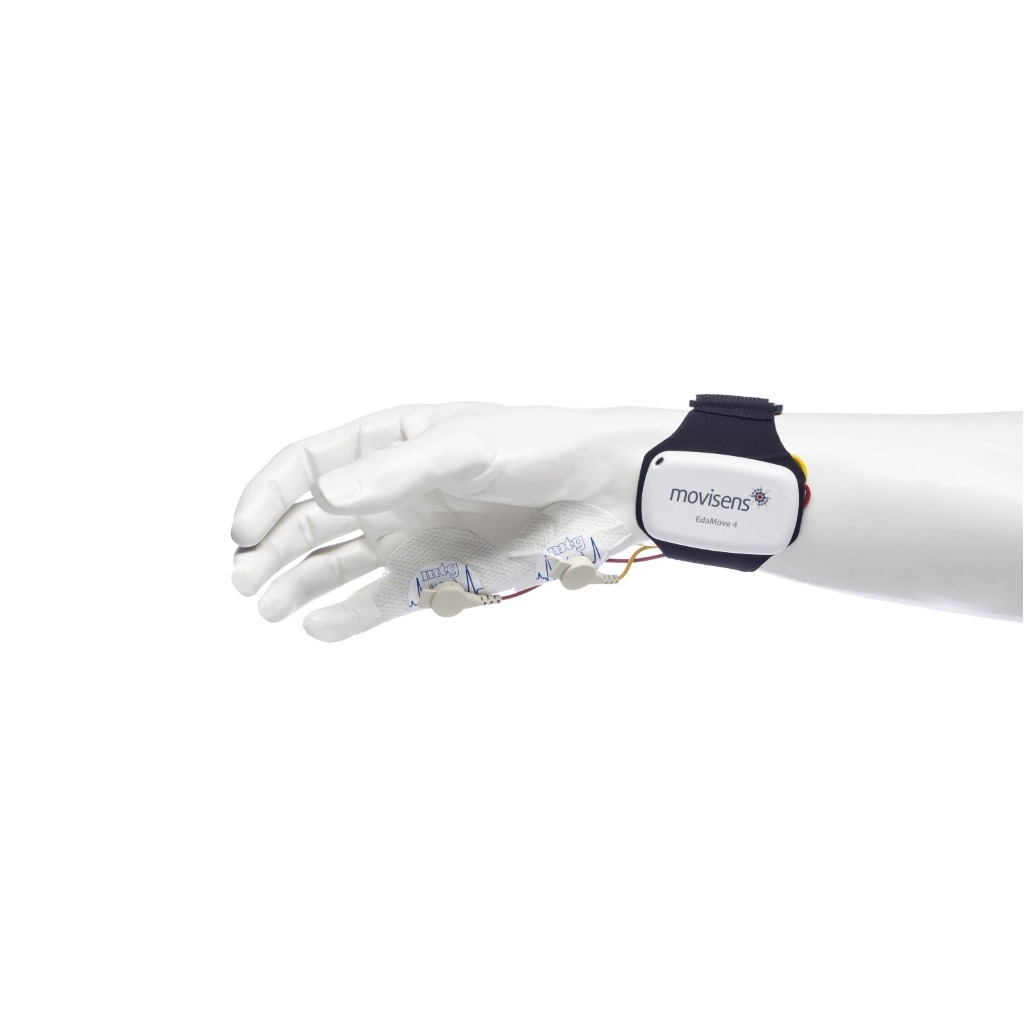
As part of the new sensor generation, the EdaMove 4 takes the proven quality of the EdaMove 3 and incorporates the most sought after improvements from extensive discussions with researchers in the field.
The 4th sensor generation offers researchers numerous advantages, including:
- New design for optimal handling: The improved case offers a sleek design aesthetic offering many practical advantages. The waterproof and dirt-repellent housing coupled with the improved carrying systems make the sensors simpler, more versatile and safer to use.
- More data collection capabilities: Thanks to the integration of the latest technologies, the 4th generation sensors now incorporate a Gyroscope (Angular Rate Sensor).
- Improved analysis possibilities: Our highly acclaimed acceleration sensor also received an overhaul, and now records the measurement data at an even higher resolution. Consequently, we’ve achieved significant improvements in the obtainable results, especially in the analysis of sedentary behavior and non-wear detection.
- Increased data retention: A new Bluetooth buffer ensures the preservation of data during disconnection, with the buffered data transferred upon reconnection; thus guaranteeing a continuous data recording at all times.
- Broader research applications: Already a class leader in quality data acquisition for many research areas, these improvements expand the EdaMove 4‘s research capabilities. All the while remaining the best choice for researcher’s requiring high quality ambulatory EDA and physical activity data.
The EdaMove 4 provides researchers with the most comprehensive tool for recording and analyzing Electrodermal (Galvanic Skin Response) and physical activity. The sensor combines our world-class 4th generation accelerometer, a high-quality EDA sensor and a Bluetooth Smart interface that allows the sensor to interact with our Experience Sampling platform, movisensXS to trigger questionnaires based on changes in physiological parameters.
Capable of capturing up to 4 weeks of data, the EdaMove 4 allows researchers to isolate and understand emotional affect with greater clarity than before. A new electrode based attachment system ensures an efficient and durable connection, recording a high quality signal with minimal effort. In addition to the EDA signal that allows the calculation of secondary parameters like skin conductance level (SCL) and skin conductance responses (SCR), the sensor acquires the raw data of the 3D acceleration of a participant, thus also allowing the calculation of activity parameters such as activity intensity with the movisens DataAnalyzer.
The additional recording of angular rate, temperature and barometric air pressure enable the swift discovery of and isolation of many of the typical artifacts that plague EDA data captured by standard ambulatory measurement systems. The EdaMove 4 connects to a comfortable textile band worn on either the wrist or ankle, increasing participant comfort and compliance, and providing greater measurement quality for researchers.