Auditory brainstem responses (ABR) or brainstem auditory evoked potentials (BAEP) measure the electrical activity of the brain’s auditory system in response to the presentation of acoustic stimuli (e.g., clicks, chirps,[…]
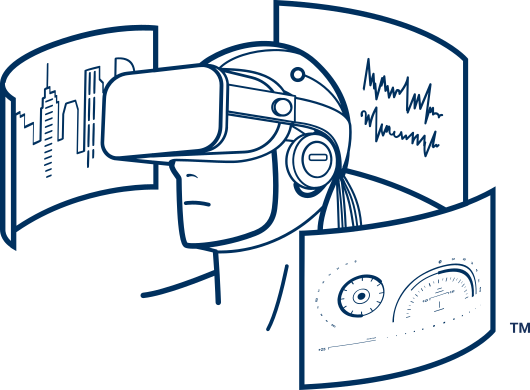
Virtual reality involves placing participants in simulated computerized environments. Often, participants wear a headset with goggles that project 3D images or videos onto their retinas, creating the sensation of immersion[…]
Child development is a fascinating area of research that is often complicated by the unique requirements (e.g., excess movement, emotional responses, sensitivity to stimuli, limited attention spans, limited verbal communication)[…]
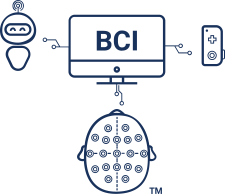
Brain-Computer Interfaces (BCIs) consist of hardware and software solutions that use the electrical activity of the brain to interact with and/or control external devices (e.g., machines). Traditionally, BCIs were home-grown[…]
Many researchers have teaching commitments, and we recognize the time and effort that goes into lesson planning with the goal of transferring knowledge about complex topics like electrophysiology and brain[…]
Electroencephalography (EEG) is the measurement of the electrical activity of the brain through specialized electrodes placed on the head. We offer passive, active, gel-based, saline, and dry-electrode technologies, so researchers[…]
Magnetoencephalography (MEG) uses high-resolution coils coupled to superconducting quantum interference devices (SQUIDs) to measure the magnetic fields associated with the electrical currents produced by neuronal activation. Unlike EEG or fNIRS,[…]
Recording videos of participants during EEG data collection is often helpful for informing both pre-processing and interpretation of the resulting EEG signals. This is particularly useful for applications in which[…]
One inherent limitation of EEG & ERP data collection is that it is virtually impossible to pinpoint the underlying neural generator (e.g., source) of the electrical signal recorded from the[…]
The average person spends about one-third of their life sleeping. A good night’s sleep is positively correlated with general well-being and cognitive function, and understanding changes in brain activity during[…]
Functional magnetic resonance imaging (fMRI) uses rapidly oscillating magnetic fields to measure changes in blood oxygenation level dependent signaling (BOLD) throughout the brain, which is often considered to be a[…]
An event-related potential (ERP) or evoked-potential (EP) is a stereotyped neurophysiological response to an internal (e.g., thought or emotion) or external (e.g., image or sound) stimulus. Often, to record a[…]
Even if it is not central to the hypothesis, eye tracking can elevate neurophysiological (EEG, fNIRS, peripheral physio, etc) research into a more comprehensive brain and behavioral investigation. By providing[…]
Functional near infrared spectroscopy (fNIRS) uses different wavelengths of near infrared light to measure changes in blood oxygenation and deoxygenation (i.e., the hemodynamic response) across the cortex, which is often[…]
Hyperscanning involves recording brain activity from more than one person at the same time. There are many advantages to these types of paradigms – particularly when it comes to understanding[…]
Mobile brain/body imaging (MoBI) is a rapidly evolving area taking neuroscience research out of the lab and into the real world. MoBI research measures fNIRS, eyetracking, peripheral physio, EEG,[…]
Neurometrics bridges the gap between raw physiological signals (EEG, ECG, GSR, EMG) and real-time insights into cognitive and emotional states, like workload, stress, and engagement. Our lightweight solutions balance data[…]
Peripheral physiology can be used to infer activation of the autonomic nervous system in response to various cognitive processes. Peripheral signals (e.g., heart rate [ECG], muscle activation [EMG], eye movements[…]
We offer professional software solutions for data acquisition, real-time visualization of underlying EEG signals in hostile recording environments (e.g., during fMRI recordings), data cleaning / pre-processing, and statistical analysis. Our[…]
Transcranial Electrical Stimulation (tES) is a general term used to describe noninvasive brain stimulation methods in which brief pulses of low-intensity electrical current are delivered to the brain through electrodes[…]
Transcranial magnetic stimulation (TMS) uses electromagnetic coils to induce brief electrical activation of brain cells in specific cortical regions. Depending on the stimulation pattern, duration, and frequency, the effects of[…]