t-Lead: Tripolar Concentric Ring Electrode (TCRE)-based sensor

What is the TCRE?

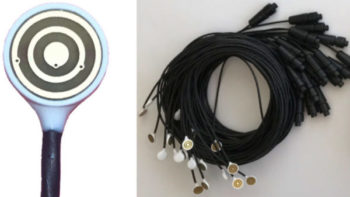
“TCRE” is the abbreviation for triploar concentric ring electrode. The invention of the TCRE represents a significant and radical improvement in the electrode design. Each TCRE consists of three electrode elements: the outer ring, the middle ring, and the center disc. The TCRE is distinctively different from the disc electrode which has a single element. The outer ring of the TCRE provides disc electrode biopotentials emulation.

What are the unique capabilities of the TCRE?

The TCRE performs the Laplacian automatically and takes bipolar differences of the surface potentials from its three closely spaced electrode elements. Noise that is common to each electrode element is automatically cancelled.

The TCRE can directly measure the Laplacian potential, improving efficiency over calculating the Laplacian from conventional disc electrodes.

The TCRE is directionally independent to global sources and highly focused on local activity due to its concentric configuration, which sharply attenuates distant signals and artifacts such as muscle artifacts and ECG. TCRE increases the signal-to-noise ratio (SNR) with high common mode noise rejection, providing automatic artifact attenuation.

The TCRE acts as high-pass spatial filters reducing the low spatial frequencies accentuating localized activity increasing the spatial selectivity.

The TCRE can be used for direct localization of the depth of electrical sources in biological tissue.

We have successfully used the TCRE for recording electroencephalography (tEEG) for evoke related potentials (ERPs), brain-computer interface (BCI), and seizure detection, electrocardiography (ECG), electromyography (EMG), and other biopotentials.
Frequently Asked Questions

Many researchers have asked us this question. What we have found is that impedance matching pastes and gels are not direct shorts like wires. We have measured the conductance of impedance matching pastes and gels and found that they are typically about the conductance of the scalp. Therefore, a millimeter separation of the tripolar electrode elements provides enough resistance in the paste that currents flowing through it cause a potential difference (Ohm’s law: V=IR). These potentials cannot be measured with conventional EEG amplifiers, so we designed our own preamplifier, the t-Interface 20, to go between the t-Leads and the conventional EEG amplifier.

No. The t-Interface 20 has been designed specifically to be compatible with your current amplifier and software. The outputs of the t-Interface 20 are standard touch-proof connectors that mate with most common amplifiers on the market today.

We only use the ground signal in our t-Interface 20. If your amplifier uses a reference signal, then it is necessary to connect a reference disc electrode to the subject and the amplifier. If your amplifier does not use a reference signal, then you only need to apply a disc electrode to the subject and connect to the ground input on your amplifier. In either case, you also need to connect the t-Interface 20 ground (Green wire) to the ground input of your amplifier. Prepare and place the disc electrodes as you normally would, and connect them to your amplifier as you normally would. If you do not have two connected isolated ground ports on your amplifier, you will need to use a jumper to connect both the ground conventional disc electrode and the Green wire of the t-Interface 20 output cable to ground on your amplifier. We do not include conventional disc electrodes with our system.

Yes. We typically use Ten20 paste.

Setting up t-Leads on the head for a recording using conductive paste takes no more time than setting up conventional disc electrodes on the head for a recording using paste.

There are no conventional EEG amplifiers, that we are aware of, that have adequate specifications to acquire signals from the t-Leads.

Further, the differencing of the outer ring and central disc, and middle ring and central disc of the t-Lead, along with the Laplacian algorithm first reported in Besio et al. 2006, is performed within the t-Interface 20 circuitry. Therefore, t-Leads will not work with a standard amplifier and you will not get the benefits of the automatic Laplacian provided by the tripolar signal.

Related Products

A black plastic EEG headset (the X.on) floats in the picture. It has seven electrode positions with white sponges for recording EEG data. As a wireless device it can be used in non-traditional recording locations.
The X.on is a mobile EEG platform that can be used with PEER to collect ERP data in places and populations you never would have imagined. It delivers research quality data at a more affordable price point.

X.on + PEER

A woman and child sit side by side at a piano to play music while both simultaneously wear the wireless and lightweight Cortivision SPECTRUM fNIRS system to record data during a hyperscanning paradigm.
The Cortivision SPECTRUM is a lightweight, wearable, wireless fNIRS platform expandable from 12 sources/8 detectors to up to 48 sources/32 detectors for whole head and DOT imaging.

Cortivision SPECTRUM

GrafiCap Dinosaurs design (G113, by Ohmz) is pictured on a mannequin. The cap has 32 green actiCAP snap holders embedded in the fabric and a fun dinosaur pattern can be seen between the holders for fun EEG recordings.
Make EEG recordings fun for your younger participants by using caps with playful printed patterns!

GrafiCap

CortiPrism provides a robust GUI for analyzing fNIRS data from Cortivision devices in single subject and group level analyses.

Cortivision CortiPrism

View Other Application Fields

Website Search

Schedule a call with our Consultants​

Please select your area to schedule an introductory call with one of our Scientific Consultants.

script here