THE way to make sure your triggers are trustworthy!
StimTrak combines creativity and precision, making it a very versatile tool which is destined to become a must-have for any kind of laboratory. It is a powerful small tool which you will love if you need a non-standard way to create triggers necessary for experiments. The only limit to its applications is your creativity.
StimTrak at a glance
- answers all your questions, like “I have a non-standard signal (e.g. sensor, external device) and I want to get a trigger out of it!”
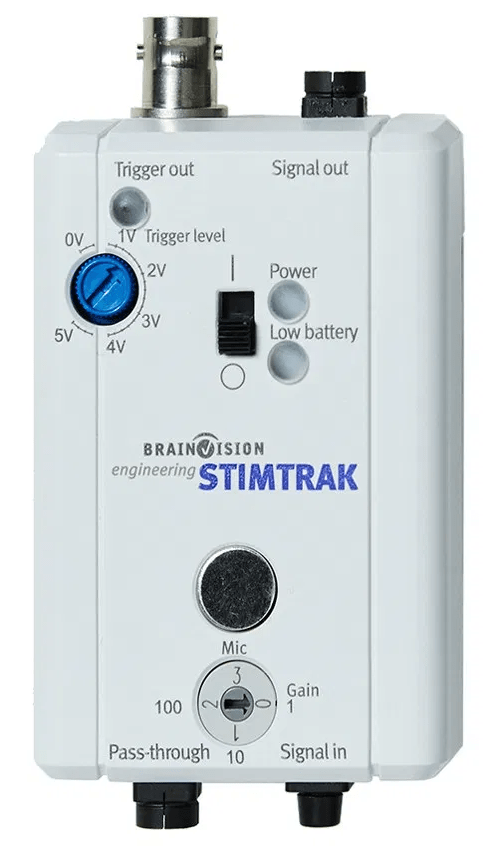
- has an input for various kinds of signals. Once the signal is in the box, it can be forwarded with the same properties or with a gain factor for amplification
- Galvanic isolation guarantees safe measurements whenever the signal will come directly from a device that is not recommended to be in contact with the subject e.g. an additional computer that is used as stimulus delivery system.
- can detect when the input signal is above an adjustable threshold level and then generates a trigger pulse
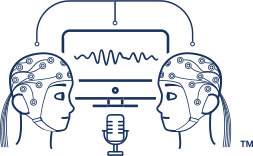
- includes a built in microphone to generate trigger pulses based on acoustical events (e.g. clapping or loud counts)
- can also be used to record voice or sounds
Doing standard ERP analysis with auditory stimuli delivered by the system … why StimTrak!?
Whenever the precision of trigger timing plays a crucial role, StimTrak is the most important companion for accurate experiments according to highest quality standards. In fact it can be used to evaluate the characteristics of your stimulus delivery system. It will discover hidden errors and enables you to eliminate them!
How to assure auditory stimulus triggers have no jitter?
With StimTrak you can determine if the trigger timing of the stimulus delivery system is really synchronous with the real stimulus presentation.
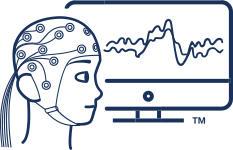
With StimTrak you can extract a lot of information about your experimental set up
Jitters and delays can be discovered and addressed in any kind of set up, allowing you to correct them and improve the quality standards of all your experiments!