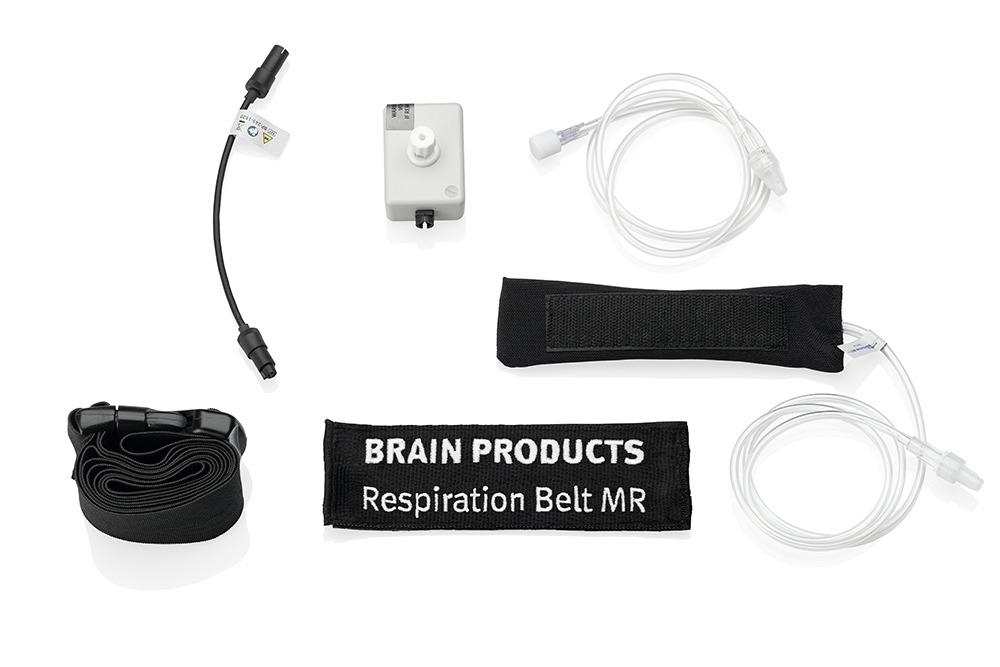
Respiration Belt MR

MR usable sensor for parallel respiratory measurements

Respiration plays a critical role in the MR environment, where it may not only be a confounding factor, but also a source of related artifacts. It can be linked to movement artifacts, physiological alterations, induced field inhomogeneity, or interference with the experimental paradigm. Therefore respiratory effects cannot be ignored (see e.g. Thomason et al. 2005).

Even if advances in data analysis techniques can provide better results at the cost of greater complexity, these results are considerably improved by parallel dedicated measurements of the sources of the artifacts. An efficient method which exploits parallel measurements for artifact correction uses acquired respiratory signals to create a principal regressor, along with other derived regressors obtained with a higher order analysis of the signal itself. This approach is known as RETROICOR (Glover et al., 2000). It is clear that a higher quality and sensitivity of acquired respiratory data will lead to an improved quality of all the regressors and finally to a higher quality of artifact correction and final denoised data, independent of the strategy adopted to correct for respiratory artifacts.

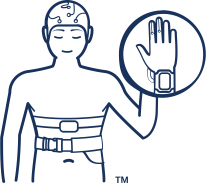
With the aim of obtaining the best data quality and the optimal method of artifact correction we have developed the Respiration Belt MR, a sensor for the acquisition of respiratory signals within MR environments.
Related Products

A black plastic EEG headset (the X.on) floats in the picture. It has seven electrode positions with white sponges for recording EEG data. As a wireless device it can be used in non-traditional recording locations.
The X.on is a mobile EEG platform that can be used with PEER to collect ERP data in places and populations you never would have imagined. It delivers research quality data at a more affordable price point.

X.on + PEER

A woman and child sit side by side at a piano to play music while both simultaneously wear the wireless and lightweight Cortivision SPECTRUM fNIRS system to record data during a hyperscanning paradigm.
The Cortivision SPECTRUM is a lightweight, wearable, wireless fNIRS platform expandable from 12 sources/8 detectors to up to 48 sources/32 detectors for whole head and DOT imaging.

Cortivision SPECTRUM

GrafiCap Dinosaurs design (G113, by Ohmz) is pictured on a mannequin. The cap has 32 green actiCAP snap holders embedded in the fabric and a fun dinosaur pattern can be seen between the holders for fun EEG recordings.
Make EEG recordings fun for your younger participants by using caps with playful printed patterns!

GrafiCap

CortiPrism provides a robust GUI for analyzing fNIRS data from Cortivision devices in single subject and group level analyses.

Cortivision CortiPrism

View Other Application Fields

Website Search

Schedule a call with our Consultants​

Please select your area to schedule an introductory call with one of our Scientific Consultants.

script here