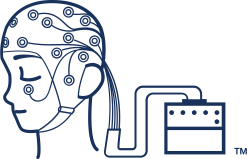
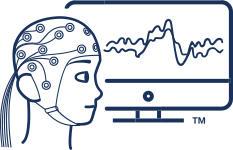
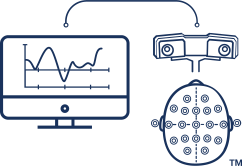
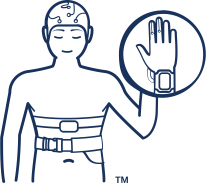
Peripheral physiology can be used to infer activation of the autonomic nervous system in response to various cognitive processes. Peripheral signals (e.g., heart rate [ECG], muscle activation [EMG], eye movements [EOG], skin conductance [GSR], respiration, acceleration, pulse oximetry, etc.) are measured by specialized electrodes and/or sensors that are placed along the body. These signals can be informative on their own, or they may be combined with EEG to inform the interpretation of the resulting waveforms. The requirements for recording clean peripheral signals often differ from those for recording clean EEG signals. For example, peripheral signals tend to be larger (e.g., on the order of mV) compared with EEG signals (e.g., on the order of µV), so there are important technical considerations to keep in mind when selecting an appropriate system for a specific research program. We offer several solutions (including amplifiers, accessories, and open-ended auxiliary cables for researchers to incorporate their own sensors) for recording peripheral physiology that can be used independently or in conjunction with EEG to answer a wide array of questions about psychophysiology. Being able to record peripheral physiology and EEG in the same data file, synchronized to the onset of specific stimuli, streamlines data pre-processing and interpretation of the results.